The Cutlite Penta LTF DUO Combo Laser: One Machine for Every Die Your Shop Runs
The Cutlite Penta LTF DUO Combo Laser: One Machine for Every Die Your Shop Runs
Most die shops reach a point where the mix of work coming in starts to outpace the equipment they have. You’re running flatbed jobs on one machine, rotary on another, and every changeover is burning time. Or you’re turning away rotary work because you can’t guarantee the accuracy within the timeline your customer needs. Either way, you’re leaving money on the table and the floor space to fix it isn’t always there.
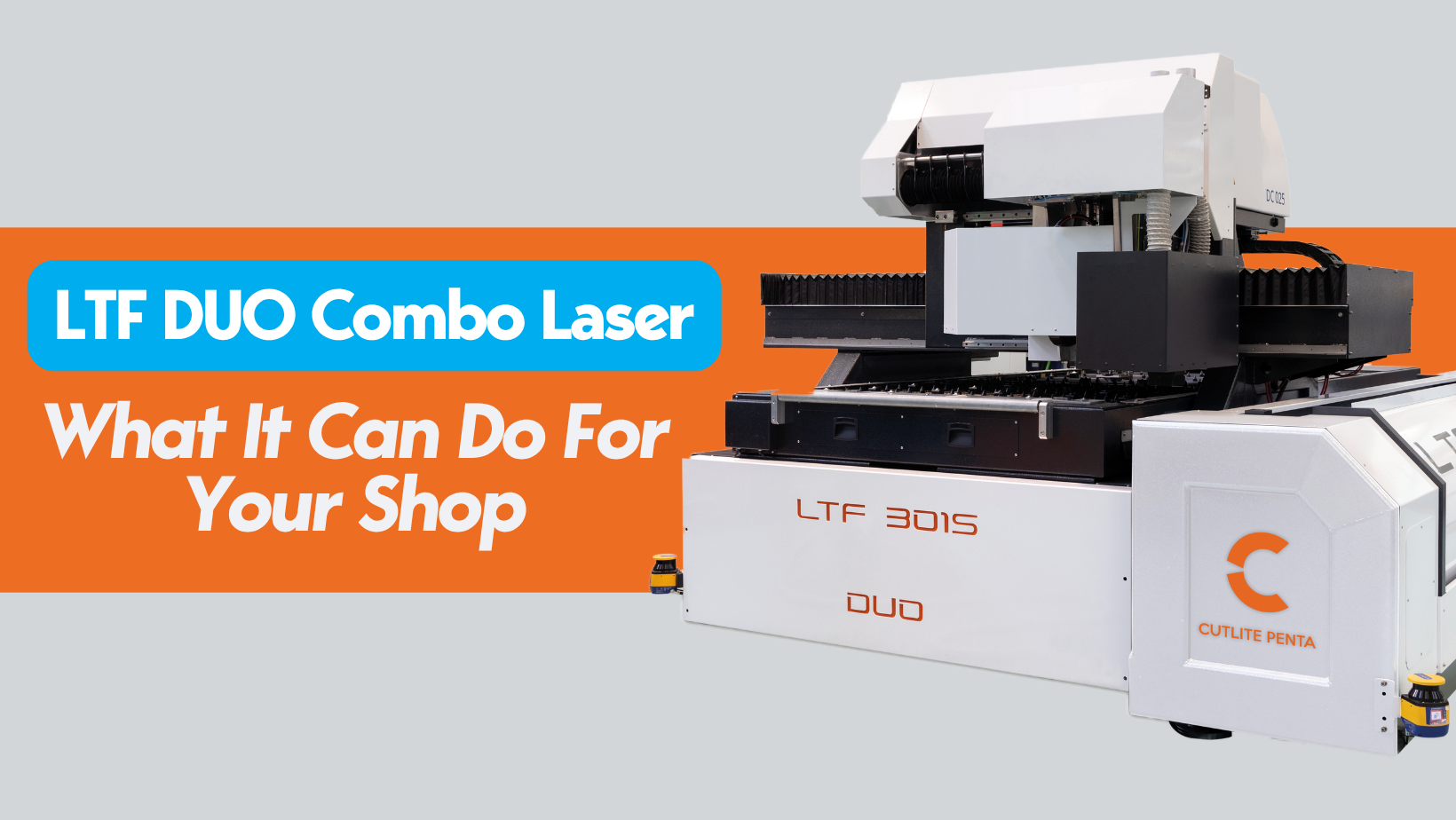
The Cutlite Penta LTF DUO was designed specifically for that situation. It combines flatbed and rotary laser cutting into a single compact system, purpose-built for die shops that need to handle the full range of work without adding square footage or headcount to make it happen.
What Is the LTF DUO?
The LTF DUO is Cutlite Penta‘s all-in-one combo laser, the most capable machine in the compact end of their lineup. It runs flatbed dies up to 3050 x 1550 mm (120.08 x 61.02 inches) and rotary dies from 177 mm to 808 mm (6.97 x 31.81 inches) in diameter and up to 3000 mm (118.11 inches) in length, all on the same machine, without a separate setup or a second piece of equipment.
This is the machine for shops that need versatility. If your customer mix includes both folding carton and corrugated work, both flatbed and rotary formats, the LTF DUO handles all of it and it does it fast.
As EZ Die in St. Louis put it: “We’re very happy with the new addition to our production line. The flexibility we now have to produce rotary and flat dies is a tremendous asset that will help us get to where we want to go!”
How the Machine Is Built
Motion System and Axes
The LTF DUO uses movable bridge architecture to provide reliable precision die cutting. The laser source rides the bridge along the X-axis, driven by magnetic linear drives, a technology that eliminates the mechanical wear points you get with traditional servo-and-ball-screw setups. The cutting head travels independently along the Y-axis. The Z-axis delivers 120 mm (4.72 inches) of travel, giving the machine range to handle material thickness variation across both flatbed board and rotary shell cutting.
The optical path on the DUO uses a single, liquid-cooled deflection mirror. A thermally stable and compact optical path matters when you’re demanding consistent kerf quality across a long production run. Heat is the enemy of accuracy, and this design accounts for it.
- Top speed: 40 m/min (131.23 ft/min)
- Acceleration: 4,000 mm/sec² (157.48 inches/sec²)
The Cutting Head and Crash Protection
The cutting head features Magnetic Crash Protection; when the head encounters an obstacle during a run, it releases magnetically rather than transferring the force into the machine structure or the board. This keeps crashes from becoming costly repairs and keeps uptime where it belongs.
This isn’t a bolt-on safety feature. It’s integrated into the head design and works in conjunction with the machine’s control software for automatic detection and recovery.
Cutting Capacity
The LTF DUO’s range is what separates it from single-format machines:
Flatbed:
- Cutting table: 3050 x 1550 mm (120.08 x 61.02 inches)
- Covers the full range of folding carton and corrugated flatbed die formats
Rotary:
- Shell diameter: 177 mm to 808 mm (6.97 x 31.81 inches)
- Shell length: up to 3000 mm (118.11 inches)
That rotary range covers virtually every cylinder diameter in use for folding carton and corrugated work in the North American market. If a customer brings you a rotary job, the DUO can run it.
Laser Source: Coherent Rofin Sinar SLAB3
The LTF DUO runs on Coherent’s third-generation Rofin Sinar SLAB3 CO₂ resonator. This is a high-efficiency laser source with a proven track record in industrial die cutting applications. SLAB technology delivers a stable, consistent beam profile — which is what you need for clean kerf edges on plywood die board and reliable mark quality on rotary shells.
Standard Features
CP Eye Camera System
The CP Eye digital camera system comes standard on the LTF DUO. Connected to the machine’s front-end software, it gives operators real-time visibility into what the machine is doing and that visibility extends to remote monitoring when the operator isn’t standing at the machine. Beyond production monitoring, the CP Eye also handles zero positioning, speeding up setup and reducing the margin for operator error at the start of a run.
CP Load Plus
Loading large die boards onto a laser isn’t always a one-person job… unless you have a table to help! The CP Load Plus uses pop-up skating rollers to let boards float across the cutting bed on a cushion of air, making accurate positioning fast and eliminating the fumbling and alignment frustration that slows down setup. It’s a small thing that adds up over the course of a full shift.
CP Clamps
Once the board is positioned, the CP Clamps hold it there. Pneumatic board clamping delivers firm, consistent board hold without manual adjustment for each job. The design prioritizes easy removal and repositioning, so board handling doesn’t become a bottleneck.
CP Rotup Plus
For rotary work, the CP Rotup Plus is the offline make-ready station that handles shell mounting before the job goes to the laser. It includes an integrated laser pointer to identify screw point locations on the shell accurately, and an onboard swiveling system for spinning the shell during the mounting process, which eliminates the awkward manual positioning that eats time during rotary setup. Shells come to the machine ready to run.
CP MSD, Metal Screw Detector
The CP MSD is a digital sensor integrated on the Z-axis that automatically detects metal screws on a rotary shell before the cutting head reaches them. When milling on a rotary shell, hitting a screw is a crash waiting to happen. The MSD prevents it with fully automatic detection driven by an intelligent algorithm; no manual flagging, no relying on the operator to remember where every screw is.
Who the LTF DUO Is Built For
This machine is for shops with real production demands and a mix of work that a single-format laser can’t handle. If you’re running flatbed work today and want to bring rotary in-house — or if you’re already running both and doing it on separate machines — the LTF DUO consolidates that into one footprint without giving up capability.
It’s also built for shops that are tired of turning work away. When a customer asks for a rotary job and the answer is “we can’t run that,” that’s a problem the LTF DUO solves directly.
The machine is compact relative to its working range. The flatbed table covers 3050 x 1550 mm, and the overall footprint stays tight — a design constraint Cutlite Penta has maintained across the LTF platform to keep the machine practical for real shop floors.
Support in North America
Cutlite Penta is the only manufacturer in the die-making industry that builds its own laser sources, cutting heads, and software — everything under one roof. When support is needed, there’s no finger-pointing between vendors.
Serviform America backs every LTF DUO in North America with:
- Factory-trained field technicians in the U.S.
- Fully stocked parts and customer service in Atlanta, GA
- Remote diagnostics and support for fast resolution without waiting on a service visit
- U.S.-based installation by technicians who know the machine
The Bottom Line
The LTF DUO is the answer for shops that need to do more with the space and crew they have. It handles the full range of flatbed and rotary die formats, runs on a proven laser platform, and comes loaded with software that’s actually designed to make daily production easier…not harder.
If your shop is ready to stop choosing between flatbed and rotary, or stop turning work away because you only have half the equipment you need, the LTF DUO is worth a conversation.
Learn more about Cutlite Penta CO2 Diemaking Laser Technology