
What Keeps Die Shops Running? The Answer Is Expert Service
Need fast support for your Serviform diemaking equipment? Our factory-...
Read More >






All five machines are CO2 dieboard lasers built by Cutlite Penta and sold, installed, and serviced in the United States by Serviform America. The right one depends on your volume, your products, and your floor space.
Not sure which machine fits your volume? Speak with a sales rep — we’ll ask about your tools per day, inches burned, and where you want to be in five years, and point you to the right laser.


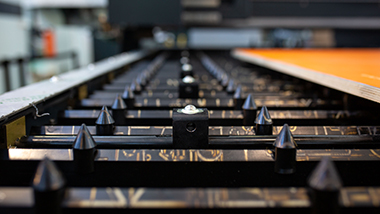


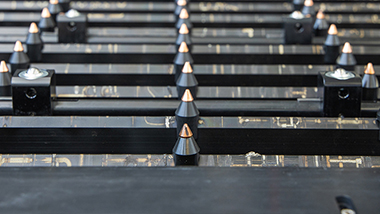


In-house die shops — converters with their own die rooms — that cut a moderate number of dies and stripping tools per day, first-time laser buyers replacing a router or milling machine, and die shops that want a compact backup laser alongside a larger machine.
No. The LTF carries the same core engineering DNA as the rest of the Cutlite Penta lineup, it's simply sized and spec'd for shops that don't need a large footprint but still demand quality cuts shift after shift.
Yes. The LTF is a CO2 flatbed laser, the correct laser type for cutting wood dieboard and plywood. CO2 wavelengths cut wood cleanly where fiber lasers cannot; with the optional CP Steel Plus head, the same machine also cuts steel counterplates with no lens change.
The LTF uses a movable bridge design. The laser source rides on the bridge and travels along the X-axis while the cutting head moves independently along the Y-axis. The Z-axis provides 80 mm of vertical travel for material thickness adjustment and focus control. All three axes working together deliver the accuracy needed for tight rule slots, crisp crease lines, and clean steel cuts.
Top speed is 40 meters per minute with acceleration of 6,000 mm/sec2. That cuts down non-cutting motion time as well as actual cutting time, without giving up kerf quality.
Every LTF runs an EL.EN. radiofrequency (RF) CO2 laser source, proven across more than 100 installations worldwide. RF resonators are compact and cost-effective to operate, no expensive gas mix setups, and deliver a stable, consistent beam, which translates directly into consistent kerf quality.
The CP Nozzle is the standard cutting head, built entirely in-house by Cutlite Penta rather than sourced from a third party. It uses a double collar magnet break-away system: if the head catches on something mid-run, it releases cleanly instead of crashing into the board or damaging the machine. During normal cutting it stays locked in tight.
Yes. The CP Nozzle works with Smart Manager 6 to compensate automatically for board unevenness, so there's no manual re-focusing or fussing with the Z-axis every time a board warps slightly.
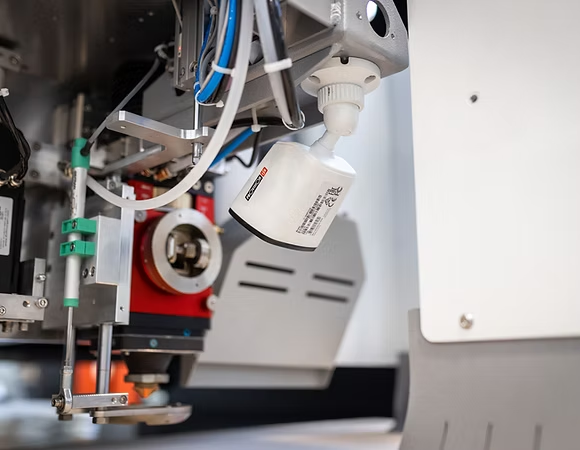
CP Eye is a digital camera system that connects directly to the machine's front-end software. It provides real-time production monitoring, including remote monitoring when you need to step away from the machine, and simplifies zero positioning, making setup faster and less dependent on operator guesswork.
Yes, that's what it was designed to do. The LTF replaces routers and milling machines with faster, cleaner, more precise laser cutting, and it's a common upgrade from aging entry-level lasers too. The advantages go beyond speed: no chips or dust since a laser doesn't generate the debris a router does, no tooling wear since laser optics have a service life measured in years rather than hours, better repeatability since a laser doesn't drift as a tool wears, quieter operation, and a smaller footprint than most routers. Cuts come out ready to rule, with no rework.
The LTF is smaller, starts at a lower price point with lower-wattage sources, and is built for moderate daily volume. The LTFP is the high-volume workhorse: bigger tables, a 120 mm Z axis, magnetic linear drives, and a duty rating of up to three shifts per day. If you're burning tools all day, every day, step up to the LTFP.